主题
23. 项目实战:文档摘要工作流
项目简介
本项目将从零构建一个智能文档摘要系统,实现:
- 📄 分块处理:将长文档拆分为可处理的片段
- ⚡ 并行摘要:使用 Send API 并行处理多个片段
- 📊 层级汇总:将片段摘要合并为最终摘要
- 🔄 质量评估:评估摘要质量并循环优化
难度等级: ⭐⭐⭐⭐
涉及知识点: 编排者-工作者模式 + 评估者-优化者模式 + 子图 + Send API
🎯 学习目标
完成本项目后,你将掌握:
- 如何使用编排者-工作者模式分解复杂任务
- 如何使用评估者-优化者模式迭代改进结果
- 如何使用 Send API 动态生成并行工作节点
- 如何实现质量评估和反馈循环
- 如何处理长文档的分块策略
项目架构
长文档 → 编排者节点
           │
           ├→ 文档分块
           │
           ├→ [Send API 动态生成] 摘要工作节点
           │   ├→ Worker 1: 摘要 Chunk 1
           │   ├→ Worker 2: 摘要 Chunk 2
           │   └→ Worker N: 摘要 Chunk N
           │
           ├→ 汇总节点(合并摘要)
           │
           └→ 评估节点
               ├→ 质量通过 → 输出最终摘要
               └→ 质量不足 → 反馈优化(循环)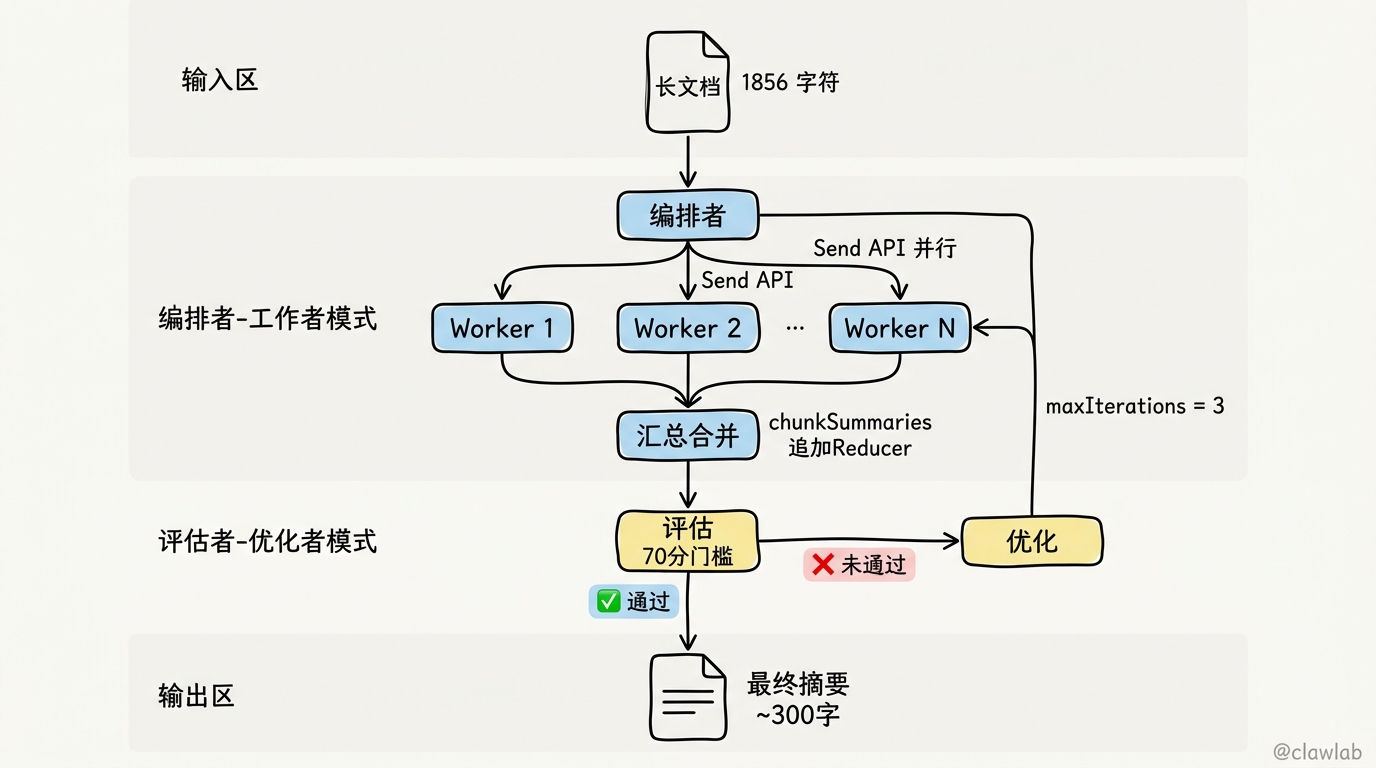
项目结构
plaintext
doc-summarizer/
├── src/
│   ├── state.ts           # 状态定义
│   ├── chunker.ts         # 文档分块工具
│   ├── nodes.ts           # 节点函数
│   ├── graph.ts           # 图构建
│   └── index.ts           # 入口文件
├── package.json
├── tsconfig.json
└── .env
第一步:项目初始化
package.json
json
{
  "name": "doc-summarizer",
  "version": "1.0.0",
  "type": "module",
  "scripts": {
    "build": "tsc",
    "start": "node dist/index.js",
    "dev": "tsx src/index.ts"
  },
  "dependencies": {
    "@langchain/langgraph": "^0.2.0",
    "@langchain/openai": "^0.3.0",
    "@langchain/core": "^0.3.0"
  },
  "devDependencies": {
    "typescript": "^5.0.0",
    "@types/node": "^20.0.0",
    "tsx": "^4.0.0"
  }
}
.env
bash
OPENAI_API_KEY=sk-xxx...第二步:状态定义
src/state.ts
typescript
import { Annotation } from "@langchain/langgraph";

export interface DocumentChunk {
  id: number;
  content: string;
  startIndex: number;
  endIndex: number;
}

export interface ChunkSummary {
  chunkId: number;
  summary: string;
  keyPoints: string[];
  wordCount: number;
}

export interface QualityEvaluation {
  score: number;
  passed: boolean;
  feedback: string;
  suggestions: string[];
}

export const SummarizerState = Annotation.Root({
  document: Annotation<string>({
    reducer: (_, update) => update,
    default: () => "",
  }),

  chunks: Annotation<DocumentChunk[]>({
    reducer: (_, update) => update,
    default: () => [],
  }),

  chunkSummaries: Annotation<ChunkSummary[]>({
    reducer: (curr, update) => [...curr, ...update],
    default: () => [],
  }),

  mergedSummary: Annotation<string>({
    reducer: (_, update) => update,
    default: () => "",
  }),

  evaluation: Annotation<QualityEvaluation | null>({
    reducer: (_, update) => update,
    default: () => null,
  }),

  finalSummary: Annotation<string>({
    reducer: (_, update) => update,
    default: () => "",
  }),

  iterationCount: Annotation<number>({
    reducer: (_, update) => update,
    default: () => 0,
  }),

  maxIterations: Annotation<number>({
    reducer: (_, update) => update,
    default: () => 3,
  }),

  currentChunk: Annotation<DocumentChunk | null>({
    reducer: (_, update) => update,
    default: () => null,
  }),

  targetLength: Annotation<number>({
    reducer: (_, update) => update,
    default: () => 500,
  }),
});

export type SummarizerStateType = typeof SummarizerState.State;
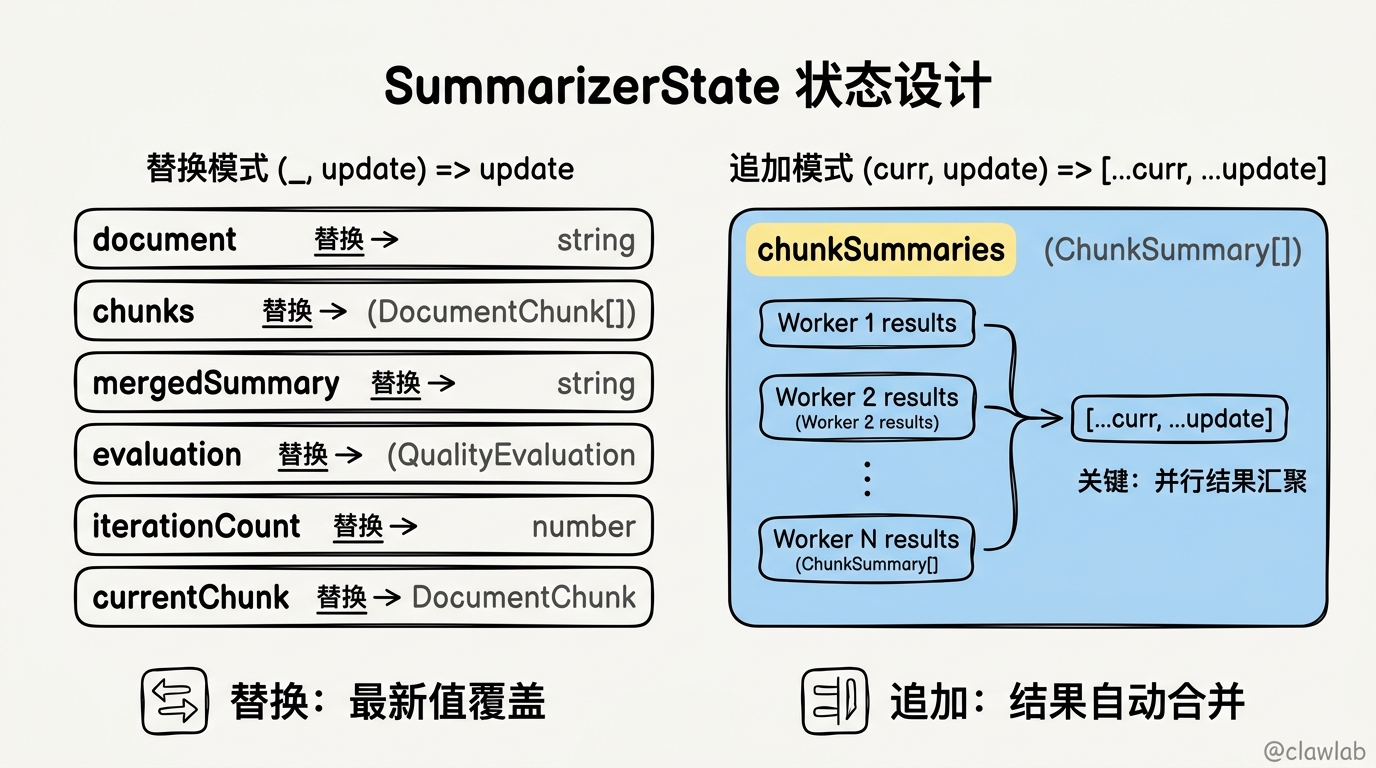
💡 人话解读:
| 状态字段 | 作用 | Reducer 策略 |
|---|---|---|
document | 原始文档内容 | 替换模式 |
chunks | 文档分块列表 | 替换模式 |
chunkSummaries | 每个分块的摘要(并行产出) | 追加模式 |
mergedSummary | 合并后的摘要 | 替换模式 |
evaluation | 质量评估结果 | 替换模式 |
finalSummary | 最终输出的摘要 | 替换模式 |
iterationCount | 当前迭代次数 | 替换模式 |
currentChunk | 当前处理的分块(用于并行) | 替换模式 |
第三步:文档分块工具
src/chunker.ts
typescript
import { DocumentChunk } from "./state.js";

export interface ChunkOptions {
  chunkSize: number;
  overlap: number;
}

export function chunkDocument(
  document: string,
  options: ChunkOptions = { chunkSize: 2000, overlap: 200 }
): DocumentChunk[] {
  const { chunkSize, overlap } = options;
  const chunks: DocumentChunk[] = [];

  const paragraphs = document.split(/\n\n+/);
  let currentChunk = "";
  let chunkStart = 0;
  let charIndex = 0;

  for (const paragraph of paragraphs) {
    if (currentChunk.length + paragraph.length > chunkSize && currentChunk.length > 0) {
      chunks.push({
        id: chunks.length,
        content: currentChunk.trim(),
        startIndex: chunkStart,
        endIndex: charIndex,
      });

      const overlapText = currentChunk.slice(-overlap);
      currentChunk = overlapText + "\n\n" + paragraph;
      chunkStart = charIndex - overlap;
    } else {
      if (currentChunk.length > 0) {
        currentChunk += "\n\n";
      }
      currentChunk += paragraph;
    }

    charIndex += paragraph.length + 2;
  }

  if (currentChunk.trim().length > 0) {
    chunks.push({
      id: chunks.length,
      content: currentChunk.trim(),
      startIndex: chunkStart,
      endIndex: charIndex,
    });
  }

  return chunks;
}

export function estimateTokens(text: string): number {
  return Math.ceil(text.length / 4);
}
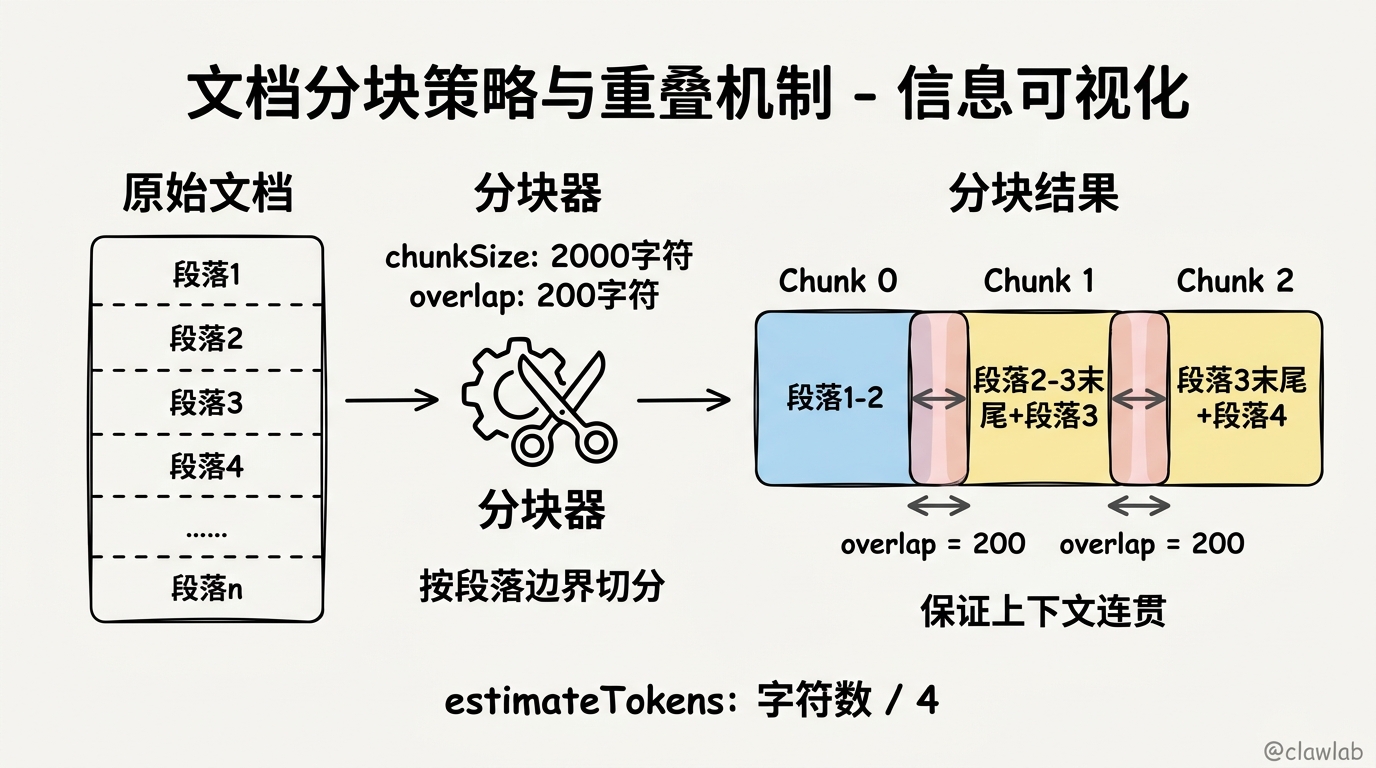
💡 分块策略说明:
原文档: "段落1...\n\n段落2...\n\n段落3...\n\n段落4..."
         │
         ▼
    ┌─────────┐
    │ 分块器  │ ← chunkSize: 2000, overlap: 200
    └────┬────┘
         │
    ┌────┴────┬────────────┐
    ▼         ▼            ▼
┌───────┐ ┌───────┐   ┌───────┐
│Chunk 0│ │Chunk 1│   │Chunk N│
│段落1-2│ │段落2-3│   │段落N  │
└───────┘ └───────┘   └───────┘
└─overlap─┘| 参数 | 默认值 | 说明 |
|---|---|---|
| chunkSize | 2000字符 | 每个分块的最大长度 |
| overlap | 200字符 | 相邻分块的重叠部分,保证上下文连贯 |
第四步:节点函数
src/nodes.ts
typescript
import { Send } from "@langchain/langgraph";
import { ChatOpenAI } from "@langchain/openai";
import { HumanMessage, SystemMessage } from "@langchain/core/messages";
import { SummarizerStateType, ChunkSummary, QualityEvaluation } from "./state.js";
import { chunkDocument } from "./chunker.js";

const llm = new ChatOpenAI({ model: "gpt-4o-mini", temperature: 0.3 });
const evaluatorLlm = new ChatOpenAI({ model: "gpt-4o-mini", temperature: 0 });

export async function orchestratorNode(state: SummarizerStateType) {
  console.log("\n🎯 编排者节点: 分析文档并分块");

  const chunks = chunkDocument(state.document, {
    chunkSize: 2000,
    overlap: 200,
  });

  console.log(`   📄 文档长度: ${state.document.length} 字符`);
  console.log(`   📦 分块数量: ${chunks.length}`);

  return {
    chunks,
    iterationCount: state.iterationCount + 1,
  };
}

export function fanOutSummaryNode(state: SummarizerStateType): Send[] {
  console.log(`\n📤 分发 ${state.chunks.length} 个摘要任务`);

  return state.chunks.map(chunk => {
    console.log(`   → Chunk ${chunk.id} (${chunk.content.length} 字符)`);
    return new Send("summarizeChunk", { currentChunk: chunk });
  });
}

export async function summarizeChunkNode(state: SummarizerStateType): Promise<{
  chunkSummaries: ChunkSummary[];
}> {
  const chunk = state.currentChunk;
  if (!chunk) {
    return { chunkSummaries: [] };
  }

  console.log(`   🔄 [Chunk ${chunk.id}] 生成摘要...`);

  const systemPrompt = `你是一个专业的文档摘要专家。请对以下文档片段生成简洁的摘要。

要求:
1. 保留关键信息和核心观点
2. 摘要长度控制在原文的 20% 以内
3. 提取 3-5 个关键要点
4. 使用客观、专业的语言

输出格式(JSON):
{
  "summary": "摘要内容",
  "keyPoints": ["要点1", "要点2", "要点3"]
}`;

  try {
    const response = await llm.invoke([
      new SystemMessage(systemPrompt),
      new HumanMessage(`请摘要以下内容:\n\n${chunk.content}`),
    ]);

    const content = response.content as string;
    const jsonMatch = content.match(/\{[\s\S]*\}/);

    if (jsonMatch) {
      const parsed = JSON.parse(jsonMatch[0]);

      console.log(`   ✅ [Chunk ${chunk.id}] 完成`);

      return {
        chunkSummaries: [{
          chunkId: chunk.id,
          summary: parsed.summary,
          keyPoints: parsed.keyPoints || [],
          wordCount: parsed.summary.length,
        }],
      };
    }
  } catch (error) {
    console.log(`   ⚠️  [Chunk ${chunk.id}] 解析失败,使用原始响应`);
  }

  const fallbackResponse = await llm.invoke([
    new SystemMessage("请用 100 字以内总结以下内容的核心要点:"),
    new HumanMessage(chunk.content),
  ]);

  return {
    chunkSummaries: [{
      chunkId: chunk.id,
      summary: fallbackResponse.content as string,
      keyPoints: [],
      wordCount: (fallbackResponse.content as string).length,
    }],
  };
}

export async function mergeNode(state: SummarizerStateType) {
  console.log("\n📥 合并节点: 汇总所有片段摘要");

  const sortedSummaries = [...state.chunkSummaries].sort((a, b) => a.chunkId - b.chunkId);

  const allSummaries = sortedSummaries.map(s => s.summary).join("\n\n");
  const allKeyPoints = sortedSummaries.flatMap(s => s.keyPoints);

  const systemPrompt = `你是一个专业的文档摘要专家。请将以下多个片段摘要合并为一个连贯、完整的最终摘要。

要求:
1. 整合所有片段的核心内容
2. 去除重复信息
3. 保持逻辑连贯性
4. 最终摘要长度约 ${state.targetLength} 字
5. 确保摘要完整覆盖原文主要内容

片段摘要:
${allSummaries}

关键要点汇总:
${allKeyPoints.map((p, i) => `${i + 1}. ${p}`).join("\n")}`;

  const response = await llm.invoke([
    new SystemMessage(systemPrompt),
    new HumanMessage("请生成最终合并摘要:"),
  ]);

  console.log(`   📝 生成合并摘要 (${(response.content as string).length} 字符)`);

  return {
    mergedSummary: response.content as string,
  };
}

export async function evaluatorNode(state: SummarizerStateType): Promise<{
  evaluation: QualityEvaluation;
}> {
  console.log("\n🔍 评估节点: 评估摘要质量");

  const systemPrompt = `你是一个摘要质量评估专家。请评估以下摘要的质量。

评估标准:
1. 完整性(0-25分):是否覆盖原文主要内容
2. 准确性(0-25分):信息是否准确无误
3. 连贯性(0-25分):逻辑是否清晰连贯
4. 简洁性(0-25分):是否简洁不冗余

总分 70 分以上为通过。

请以 JSON 格式输出:
{
  "score": 总分数,
  "passed": true/false,
  "feedback": "整体评价",
  "suggestions": ["改进建议1", "改进建议2"]
}`;

  const response = await evaluatorLlm.invoke([
    new SystemMessage(systemPrompt),
    new HumanMessage(`原文片段数: ${state.chunks.length}
目标长度: ${state.targetLength} 字
当前摘要长度: ${state.mergedSummary.length} 字
当前迭代: ${state.iterationCount}/${state.maxIterations}

摘要内容:
${state.mergedSummary}`),
  ]);

  try {
    const content = response.content as string;
    const jsonMatch = content.match(/\{[\s\S]*\}/);

    if (jsonMatch) {
      const evaluation = JSON.parse(jsonMatch[0]) as QualityEvaluation;

      console.log(`   📊 评分: ${evaluation.score}/100`);
      console.log(`   ${evaluation.passed ? "✅ 通过" : "❌ 未通过"}: ${evaluation.feedback}`);

      return { evaluation };
    }
  } catch (error) {
    console.log("   ⚠️  评估解析失败,默认通过");
  }

  return {
    evaluation: {
      score: 75,
      passed: true,
      feedback: "默认通过",
      suggestions: [],
    },
  };
}

export async function optimizerNode(state: SummarizerStateType) {
  console.log("\n🔧 优化节点: 根据反馈改进摘要");

  const suggestions = state.evaluation?.suggestions || [];

  const systemPrompt = `你是一个摘要优化专家。请根据以下反馈改进摘要。

当前摘要:
${state.mergedSummary}

评估反馈:${state.evaluation?.feedback}

改进建议:
${suggestions.map((s, i) => `${i + 1}. ${s}`).join("\n")}

目标长度: ${state.targetLength} 字

请输出改进后的摘要:`;

  const response = await llm.invoke([
    new SystemMessage(systemPrompt),
    new HumanMessage("请生成改进后的摘要:"),
  ]);

  console.log(`   📝 优化后摘要 (${(response.content as string).length} 字符)`);

  return {
    mergedSummary: response.content as string,
    chunkSummaries: [],
  };
}

export function finalizeNode(state: SummarizerStateType) {
  console.log("\n✅ 完成节点: 输出最终摘要");

  return {
    finalSummary: state.mergedSummary,
  };
}

export function routeAfterEvaluation(state: SummarizerStateType): string {
  if (state.evaluation?.passed) {
    console.log("   → 质量通过,输出最终结果");
    return "finalize";
  }

  if (state.iterationCount >= state.maxIterations) {
    console.log("   → 达到最大迭代次数,强制输出");
    return "finalize";
  }

  console.log(`   → 质量未达标,进入第 ${state.iterationCount + 1} 次优化`);
  return "optimize";
}
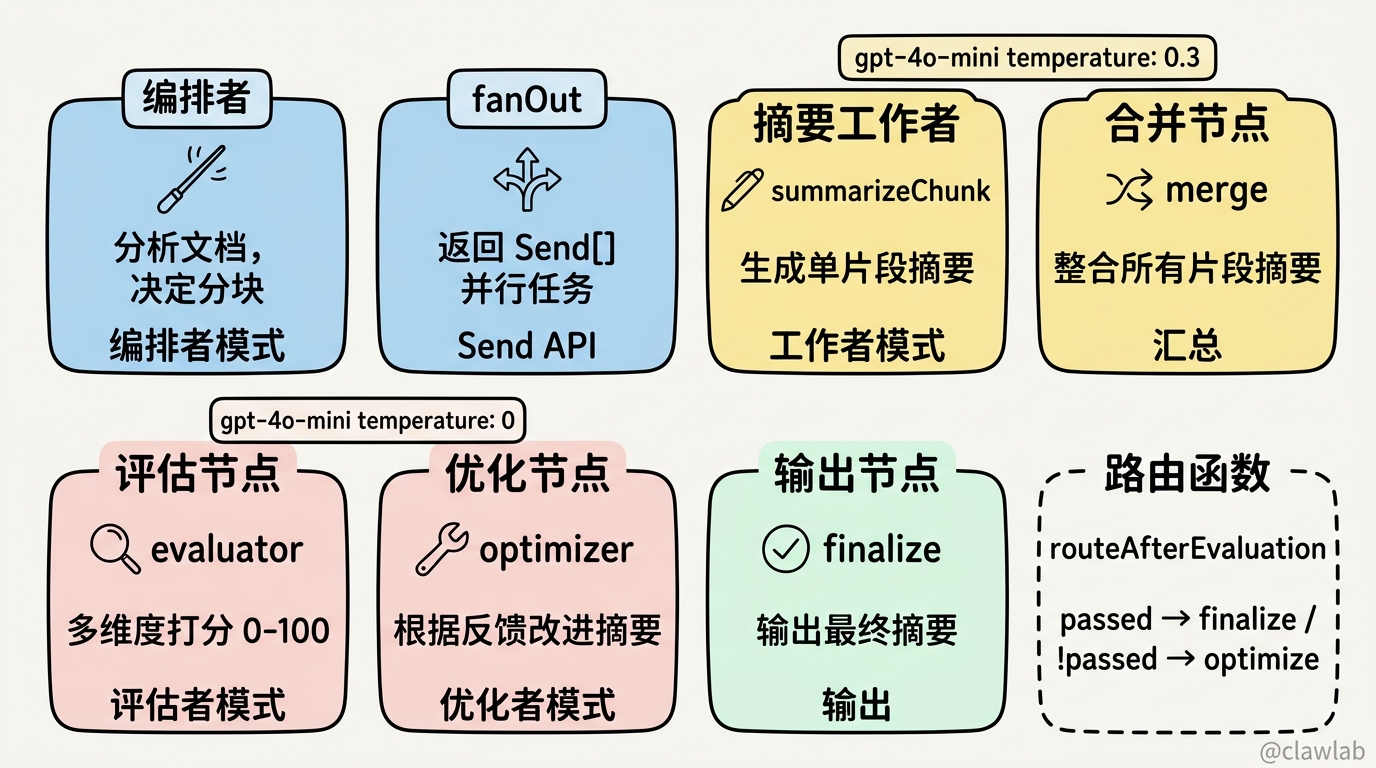
💡 人话解读:
| 节点 | 模式 | 作用 |
|---|---|---|
orchestratorNode | 编排者 | 分析文档,决定如何分块 |
fanOutSummaryNode | Send API | 创建并行摘要任务 |
summarizeChunkNode | 工作者 | 生成单个片段的摘要 |
mergeNode | 汇总 | 合并所有片段摘要 |
evaluatorNode | 评估者 | 评估摘要质量 |
optimizerNode | 优化者 | 根据反馈改进摘要 |
finalizeNode | 输出 | 输出最终结果 |
第五步:构建图
src/graph.ts
typescript
import { StateGraph, START, END, MemorySaver } from "@langchain/langgraph";
import { SummarizerState } from "./state.js";
import {
  orchestratorNode,
  fanOutSummaryNode,
  summarizeChunkNode,
  mergeNode,
  evaluatorNode,
  optimizerNode,
  finalizeNode,
  routeAfterEvaluation,
} from "./nodes.js";

const graph = new StateGraph(SummarizerState)
  .addNode("orchestrator", orchestratorNode)
  .addNode("fanOutSummary", fanOutSummaryNode)
  .addNode("summarizeChunk", summarizeChunkNode)
  .addNode("merge", mergeNode)
  .addNode("evaluator", evaluatorNode)
  .addNode("optimizer", optimizerNode)
  .addNode("finalize", finalizeNode)

  .addEdge(START, "orchestrator")
  .addEdge("orchestrator", "fanOutSummary")
  .addEdge("summarizeChunk", "merge")
  .addEdge("merge", "evaluator")
  .addConditionalEdges("evaluator", routeAfterEvaluation, {
    optimize: "optimizer",
    finalize: "finalize",
  })
  .addEdge("optimizer", "fanOutSummary")
  .addEdge("finalize", END);

const checkpointer = new MemorySaver();

export const docSummarizer = graph.compile({ checkpointer });
💡 流程图:
START
  │
  ▼
┌─────────────┐
│ orchestrator│ ← 分析文档,创建分块
└──────┬──────┘
       │
       ▼
┌──────────────┐
│ fanOutSummary│ ← 返回 Send[]
└──────┬───────┘
       │
    ┌──┴──┬──────┬──────┐
    ▼     ▼      ▼      ▼
┌──────┐┌──────┐┌──────┐┌──────┐
│Chunk0││Chunk1││Chunk2││ChunkN│  ← 并行摘要
└──┬───┘└──┬───┘└──┬───┘└──┬───┘
   │       │       │       │
   └───────┴───────┴───────┘
                │
                ▼
          ┌───────────┐
          │   merge   │ ← 合并摘要
          └─────┬─────┘
                │
                ▼
          ┌───────────┐
          │ evaluator │ ← 质量评估
          └─────┬─────┘
                │
        ┌───────┴───────┐
        │               │
   passed=true    passed=false
        │               │
        ▼               ▼
  ┌──────────┐   ┌───────────┐
  │ finalize │   │ optimizer │ ← 优化改进
  └────┬─────┘   └─────┬─────┘
       │               │
       ▼               └──→ fanOutSummary(循环)
      END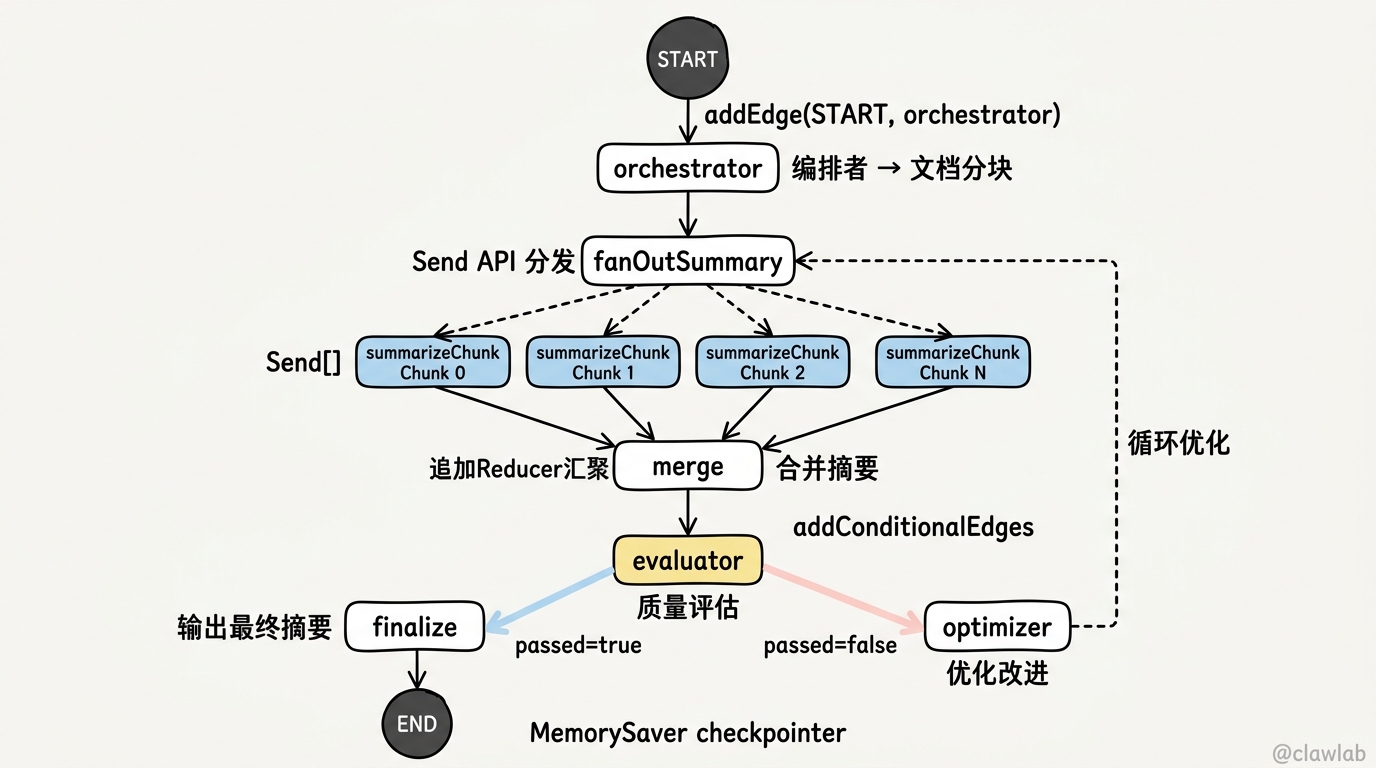
第六步:入口文件
src/index.ts
typescript
import { docSummarizer } from "./graph.js";

const sampleDocument = `
人工智能的发展历程

人工智能(Artificial Intelligence,简称AI)是计算机科学的一个分支,它致力于研究和开发能够模拟人类智能行为的系统。从1956年达特茅斯会议正式提出"人工智能"这一概念以来,这一领域经历了数次起伏。

早期发展(1956-1974)

这一时期被称为AI的"黄金时代"。研究者们充满乐观,认为完全模拟人类智能的机器很快就会实现。主要成就包括:通用问题求解器(GPS)的开发、LISP编程语言的创建,以及早期专家系统的尝试。然而,由于计算能力的限制和对问题复杂性的低估,这一时期的许多预言都未能实现。

第一次AI寒冬(1974-1980)

由于早期承诺未能兑现,AI研究经费大幅削减。批评者指出,AI系统只能处理"玩具问题",无法应对现实世界的复杂性。这一时期的困境推动了对知识表示和专家系统的深入研究。

专家系统时代(1980-1987)

专家系统的成功为AI带来了新的投资热潮。MYCIN、DENDRAL等系统在医学诊断和化学分析领域取得了令人瞩目的成果。日本提出的第五代计算机计划更是将这股热潮推向顶峰。

第二次AI寒冬(1987-1993)

专家系统的局限性逐渐暴露。它们难以维护、成本高昂,且只能处理狭窄领域的问题。随着个人电脑的普及和专用AI硬件市场的崩溃,AI再次进入低谷。

现代AI复兴(1993至今)

互联网的兴起带来了海量数据,计算能力的提升使深度学习成为可能。2012年,深度学习在ImageNet竞赛中大放异彩,标志着AI新时代的到来。此后,AI在图像识别、自然语言处理、游戏、自动驾驶等领域取得了突破性进展。

当前发展与挑战

今天的AI技术已经深入日常生活。智能手机中的语音助手、推荐系统、人脸识别等都是AI的应用。然而,我们也面临着重要的挑战:AI的可解释性、公平性、隐私保护,以及对就业市场的影响等问题都需要认真对待。

大型语言模型(如GPT系列)的出现更是将AI推向了新的高度。这些模型展示了令人惊叹的自然语言理解和生成能力,但同时也引发了关于AI安全、虚假信息和知识产权等方面的讨论。

未来展望

人工智能的未来充满可能性。从通用人工智能(AGI)的探索,到AI与其他技术(如量子计算、脑机接口)的融合,再到AI在气候变化、医疗健康、科学发现等领域的应用,AI正在重塑我们的世界。

然而,技术的发展必须与伦理考量相平衡。确保AI的发展造福全人类,避免其被滥用,是我们这一代人的重要责任。
`;

async function runDocSummarizer() {
  console.log("═".repeat(60));
  console.log("📄 文档摘要工作流");
  console.log("═".repeat(60));

  const config = {
    configurable: {
      thread_id: `summary-${Date.now()}`,
    },
  };

  console.log(`\n📋 输入文档: ${sampleDocument.length} 字符`);

  const startTime = Date.now();

  const result = await docSummarizer.invoke(
    {
      document: sampleDocument,
      targetLength: 300,
      maxIterations: 3,
    },
    config
  );

  const totalTime = Date.now() - startTime;

  console.log("\n" + "═".repeat(60));
  console.log("📊 处理结果");
  console.log("═".repeat(60));

  console.log(`\n📈 统计信息:`);
  console.log(`   原文长度: ${sampleDocument.length} 字符`);
  console.log(`   摘要长度: ${result.finalSummary?.length || 0} 字符`);
  console.log(`   压缩比: ${((result.finalSummary?.length || 0) / sampleDocument.length * 100).toFixed(1)}%`);
  console.log(`   分块数量: ${result.chunks?.length || 0}`);
  console.log(`   迭代次数: ${result.iterationCount}`);
  console.log(`   处理耗时: ${totalTime}ms`);

  if (result.evaluation) {
    console.log(`\n📊 质量评估:`);
    console.log(`   评分: ${result.evaluation.score}/100`);
    console.log(`   状态: ${result.evaluation.passed ? "✅ 通过" : "❌ 未通过"}`);
    console.log(`   反馈: ${result.evaluation.feedback}`);
  }

  console.log("\n" + "─".repeat(60));
  console.log("📝 最终摘要:");
  console.log("─".repeat(60));
  console.log(result.finalSummary);
  console.log("─".repeat(60));

  if (result.chunkSummaries && result.chunkSummaries.length > 0) {
    console.log("\n📦 片段摘要详情:");
    result.chunkSummaries.forEach((cs: any) => {
      console.log(`\n   [Chunk ${cs.chunkId}] (${cs.wordCount} 字)`);
      console.log(`   ${cs.summary.slice(0, 100)}...`);
      if (cs.keyPoints?.length > 0) {
        console.log(`   要点: ${cs.keyPoints.slice(0, 3).join("; ")}`);
      }
    });
  }

  console.log("\n" + "═".repeat(60));

  return result;
}

runDocSummarizer().catch(console.error);
第七步:运行测试
bash
npm install

npm run dev
预期输出
════════════════════════════════════════════════════════════
📄 文档摘要工作流
════════════════════════════════════════════════════════════

📋 输入文档: 1856 字符

🎯 编排者节点: 分析文档并分块
   📄 文档长度: 1856 字符
   📦 分块数量: 2

📤 分发 2 个摘要任务
   → Chunk 0 (1024 字符)
   → Chunk 1 (832 字符)
   🔄 [Chunk 0] 生成摘要...
   🔄 [Chunk 1] 生成摘要...
   ✅ [Chunk 0] 完成
   ✅ [Chunk 1] 完成

📥 合并节点: 汇总所有片段摘要
   📝 生成合并摘要 (312 字符)

🔍 评估节点: 评估摘要质量
   📊 评分: 82/100
   ✅ 通过: 摘要完整覆盖了文档主要内容,逻辑清晰
   → 质量通过,输出最终结果

✅ 完成节点: 输出最终摘要

════════════════════════════════════════════════════════════
📊 处理结果
════════════════════════════════════════════════════════════

📈 统计信息:
   原文长度: 1856 字符
   摘要长度: 312 字符
   压缩比: 16.8%
   分块数量: 2
   迭代次数: 1
   处理耗时: 4523ms

📊 质量评估:
   评分: 82/100
   状态: ✅ 通过
   反馈: 摘要完整覆盖了文档主要内容,逻辑清晰

────────────────────────────────────────────────────────────
📝 最终摘要:
────────────────────────────────────────────────────────────
人工智能自1956年提出以来经历了多次起伏:早期黄金时代(1956-1974)取得GPS和LISP等成就,
随后经历两次寒冬。专家系统时代(1980-1987)带来短暂繁荣。现代AI复兴始于2012年深度学习
突破,如今广泛应用于语音助手、图像识别等领域。大型语言模型的出现将AI推向新高度,同时
也带来安全、伦理等挑战。未来AI将继续发展,但需平衡技术进步与伦理考量。
────────────────────────────────────────────────────────────

📦 片段摘要详情:

   [Chunk 0] (156 字)
   人工智能自1956年达特茅斯会议提出以来,经历了黄金时代、两次寒冬、专家系统时代等阶段...
   要点: AI经历多次起伏; 早期因计算能力限制受阻; 专家系统时代带来短暂繁荣

   [Chunk 1] (148 字)
   现代AI复兴始于深度学习突破,在图像识别、自然语言处理等领域取得重大进展...
   要点: 深度学习推动AI复兴; 大型语言模型展示强大能力; 技术发展需与伦理平衡

════════════════════════════════════════════════════════════
进阶功能:流式输出进度
修改 src/index.ts(流式版本)
typescript
async function runWithStreaming() {
  console.log("═".repeat(60));
  console.log("📄 文档摘要工作流(流式输出)");
  console.log("═".repeat(60));

  const config = {
    configurable: {
      thread_id: `summary-${Date.now()}`,
    },
  };

  const stream = await docSummarizer.stream(
    {
      document: sampleDocument,
      targetLength: 300,
      maxIterations: 3,
    },
    { ...config, streamMode: "updates" }
  );

  console.log("\n📡 实时进度:\n");

  for await (const update of stream) {
    const [nodeName, nodeOutput] = Object.entries(update)[0];

    switch (nodeName) {
      case "orchestrator":
        console.log(`🎯 分块完成: ${nodeOutput.chunks?.length} 个片段`);
        break;
      case "summarizeChunk":
        const cs = nodeOutput.chunkSummaries?.[0];
        if (cs) {
          console.log(`✅ Chunk ${cs.chunkId} 摘要完成 (${cs.wordCount} 字)`);
        }
        break;
      case "merge":
        console.log(`📥 合并完成: ${nodeOutput.mergedSummary?.length} 字符`);
        break;
      case "evaluator":
        const ev = nodeOutput.evaluation;
        console.log(`🔍 评估完成: ${ev?.score}/100 ${ev?.passed ? "✅" : "❌"}`);
        break;
      case "optimizer":
        console.log(`🔧 优化完成: ${nodeOutput.mergedSummary?.length} 字符`);
        break;
      case "finalize":
        console.log(`\n✅ 最终摘要:\n${nodeOutput.finalSummary}`);
        break;
    }
  }
}
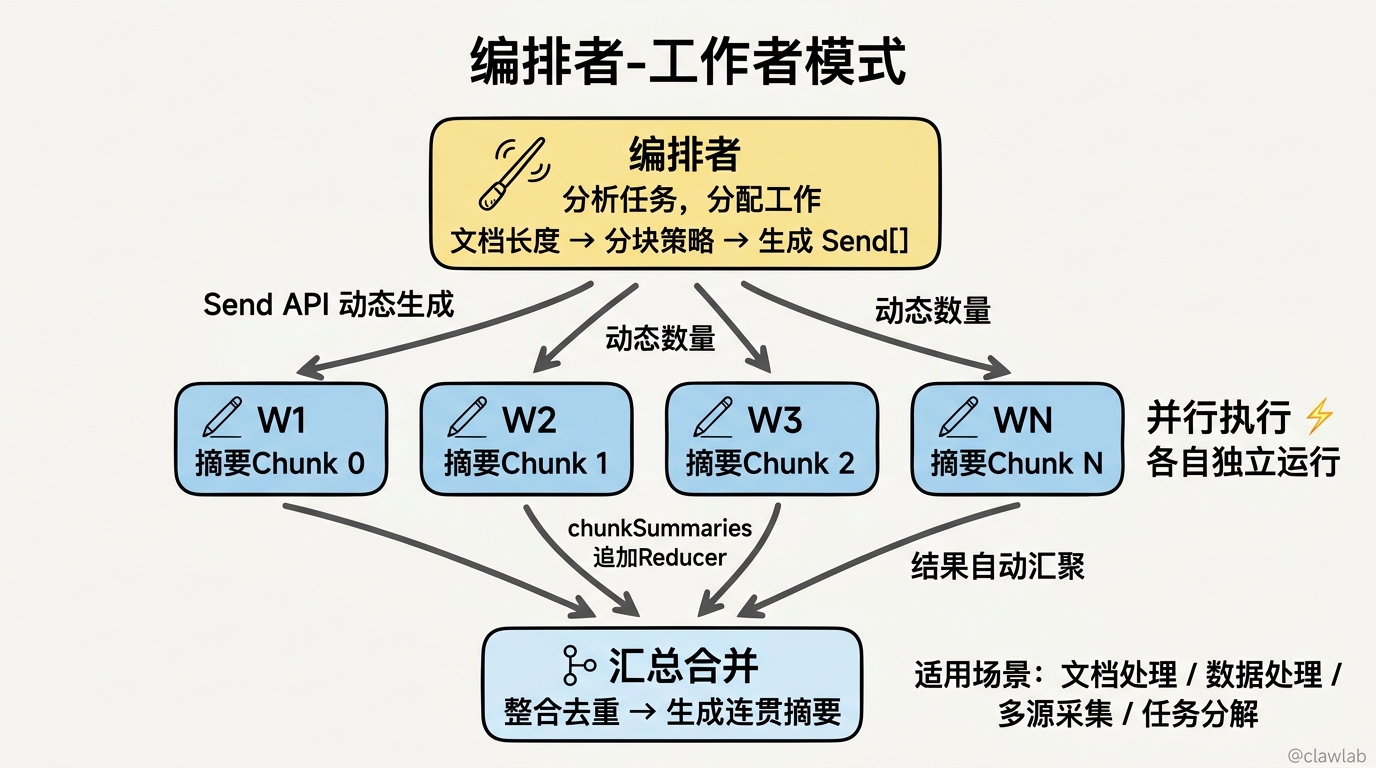
编排者-工作者模式详解
模式对比
┌─────────────────────────────────────────────────────────────┐
│                    编排者-工作者模式                         │
├─────────────────────────────────────────────────────────────┤
│                                                             │
│     ┌────────────┐                                          │
│     │  编排者    │ ← 分析任务,分配工作                      │
│     └─────┬──────┘                                          │
│           │                                                 │
│    ┌──────┼──────┬──────┐                                   │
│    ▼      ▼      ▼      ▼                                   │
│  ┌────┐┌────┐┌────┐┌────┐                                   │
│  │W1  ││W2  ││W3  ││WN  │  ← 工作者(并行执行)              │
│  └──┬─┘└──┬─┘└──┬─┘└──┬─┘                                   │
│     │     │     │     │                                     │
│     └─────┴─────┴─────┘                                     │
│             │                                               │
│             ▼                                               │
│     ┌────────────┐                                          │
│     │  汇总节点  │ ← 合并所有结果                            │
│     └────────────┘                                          │
│                                                             │
└─────────────────────────────────────────────────────────────┘
适用场景
| 场景 | 说明 |
|---|---|
| 文档处理 | 将长文档分块并行处理 |
| 数据处理 | 批量数据的并行转换 |
| 多源采集 | 从多个来源并行获取数据 |
| 任务分解 | 将复杂任务拆分为独立子任务 |
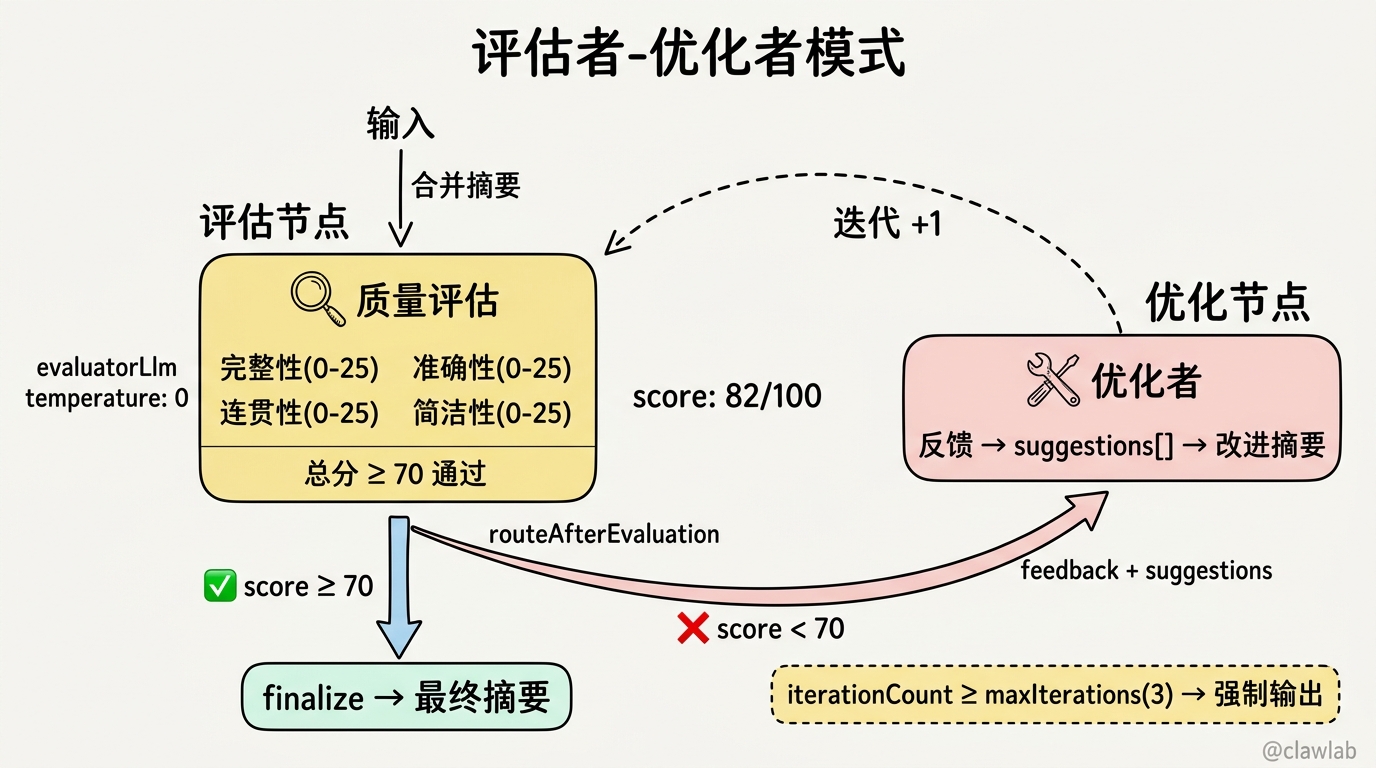
评估者-优化者模式详解
模式对比
┌─────────────────────────────────────────────────────────────┐
│                    评估者-优化者模式                         │
├─────────────────────────────────────────────────────────────┤
│                                                             │
│     ┌────────────┐                                          │
│     │  生成结果  │                                          │
│     └─────┬──────┘                                          │
│           │                                                 │
│           ▼                                                 │
│     ┌────────────┐                                          │
│     │  评估节点  │ ← 评估结果质量                            │
│     └─────┬──────┘                                          │
│           │                                                 │
│     ┌─────┴─────┐                                           │
│     │           │                                           │
│  通过 ✅     未通过 ❌                                        │
│     │           │                                           │
│     ▼           ▼                                           │
│  ┌──────┐  ┌──────────┐                                     │
│  │ 输出 │  │ 优化节点 │ ← 根据反馈改进                       │
│  └──────┘  └────┬─────┘                                     │
│                 │                                           │
│                 └──────→ 评估节点(循环直到通过)            │
│                                                             │
└─────────────────────────────────────────────────────────────┘
关键代码
typescript
function routeAfterEvaluation(state: SummarizerStateType): string {
  if (state.evaluation?.passed) {
    return "finalize";
  }

  if (state.iterationCount >= state.maxIterations) {
    return "finalize";
  }

  return "optimize";
}
项目总结
核心实现
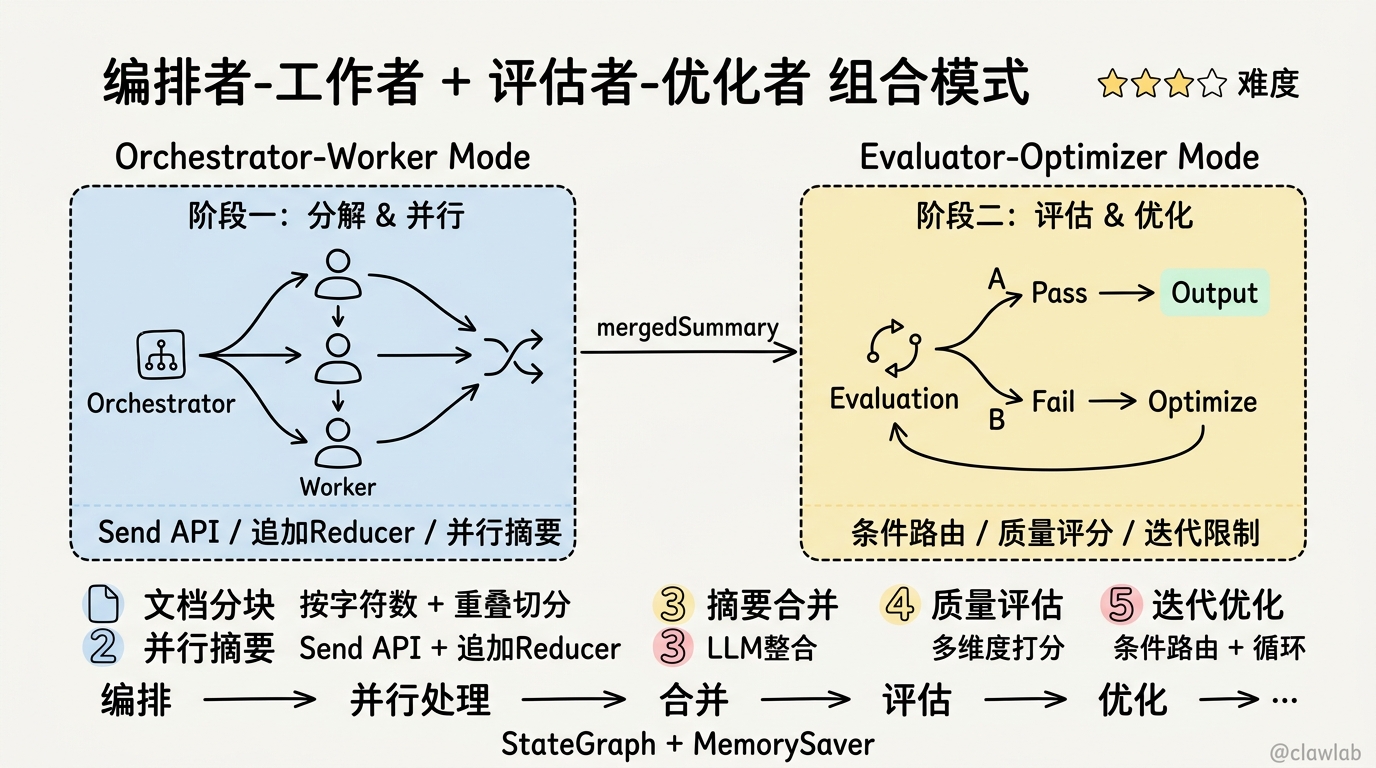
| 功能 | 实现方式 |
|---|---|
| 文档分块 | 按字符数 + 重叠切分 |
| 并行摘要 | Send API + 追加 Reducer |
| 摘要合并 | LLM 整合多片段摘要 |
| 质量评估 | LLM 多维度打分 |
| 迭代优化 | 条件路由 + 循环 |
两种模式组合
编排者-工作者模式                评估者-优化者模式
      │                               │
      │                               │
      ▼                               ▼
┌───────────────────────────────────────────────┐
│                                               │
│  编排 → 并行处理 → 合并 → 评估 → 优化 → ...  │
│                                               │
└───────────────────────────────────────────────┘
流程控制关键点
| 控制点 | 实现方式 |
|---|---|
| 并行分发 | fanOutNode 返回 Send[] |
| 结果汇聚 | Reducer 追加模式 |
| 质量门槛 | evaluator 评分 + 条件路由 |
| 迭代限制 | maxIterations 防止无限循环 |
核心要点回顾
- 编排者-工作者模式 —— 编排者分析任务,工作者并行执行
- 评估者-优化者模式 —— 评估质量,不达标则循环优化
- Send API 动态并行 —— 根据分块数量动态创建并行任务
- 追加 Reducer 汇聚结果 —— 多个并行任务的结果自动合并
- 迭代限制防止死循环 ——
maxIterations是安全保障
下一步
继续学习下一个项目:自主研究 Agent,学习 Agent 模式和工具调用循环的实战应用。